Somewhere on your property there's a tree you've stopped trusting. The ash beside the driveway that never leafed out this spring. The white oak that seems to tip a little closer to the house after every storm. The hemlock over the cabin deck that sheds bigger deadwood each year. Reliable Tree Service has handled tree removal in Logan, Ohio since 2015 — 5,000 projects across eleven years of complete Hocking Hills tree care, from tight in-town lots to ridge-top gravel drives. We take down hazardous, dead, storm-damaged, and simply in-the-way trees for homes, cabins, and businesses, we're bonded and insured, and every job starts with a written estimate.
When a Tree Needs to Come Down
Trees usually tell you before they fail. The trouble is knowing which signals matter.
A tree leaning toward the house is the one that keeps people up at night, and the detail that separates worry from emergency is whether the lean is new. A tree that has leaned the same way for decades has grown its wood to carry that load. A lean that's increasing — especially with cracked or mounded soil at the base — means the root plate itself is shifting. Those trees rarely re-anchor. Treat it as urgent.
A dead or dying tree announces itself in stages: thin, late leaf-out one year, bare limbs the next, then bark sloughing off in plates and woodpeckers hammering after the insects underneath. Dead tree removal is simplest early, while the wood still holds together; the longer it stands, the more brittle and expensive it gets.
Mushrooms or shelf fungus at the base are the quiet red flag most homeowners walk past. Fungus fruiting at the root flare means advanced decay in the exact wood that holds the tree upright — the outside can look healthy while the anchor rots.
Add storm-split trunks, hanging limbs lodged in the crown, and big deadwood shedding over roofs and parked cars, and you have the honest list. Not every worrying tree belongs on it, though — a healthy tree that's merely overgrown can usually be pruned instead. Not sure if a tree needs to come down? Get an assessment and we'll tell you straight, even when the answer is "keep it."
Why Trees Fail Differently Around Logan and the Hocking Hills
Tree removal here isn't the same job it is in flat suburban Columbus, and three local facts explain most of the calls we take.
Standing-dead ash is everywhere. Hocking County sits under Ohio's emerald ash borer quarantine, and the borer has already killed most of the white and green ash in the county. Those trees are still standing — along driveways, over yards, beside cabin lots — and every year they stand, the wood gets more brittle and the removal gets riskier. Dead ash is now the most common dead tree removal we do, and often the most technical.
Ice is the defining storm. The February 2022 ice storm hit Hocking County harder than any of Ohio's other 87 counties — ice-loaded trees and limbs came down on lines and roads across the county and triggered a State of Emergency. Trees that survived often carry cracked limbs and split unions that fail quietly a season or two later.
The terrain fights you. This is ridge-and-gorge sandstone country: steep slopes, cliff edges, narrow gravel cabin drives, and thin ridge-top soils that let saturated windstorms uproot whole trees. Many removals around here can't be a simple drop into open lawn — they're rigging jobs, and sometimes crane jobs. With well over a thousand vacation rentals in the Logan area, a large share of our work is hemlocks and oaks over cabins, decks, and hot tubs, where "close enough" isn't a cleanup plan.
How We Take a Tree Down Safely
Neither speed nor horsepower makes a removal safe. The plan does. Here's the professional tree cutting service workflow every removal follows.
It starts with the estimate. We read the tree — height, lean, decay, deadwood — and everything underneath it: roofline, power drop, septic field, landscaping, the neighbor's fence. We check access, because whether a lift can reach the trunk changes the whole approach. You get a written estimate before anything is scheduled.
Then the rigging plan. Climbing or bucket access, rigging points, drop zone, protection for what's below. Nothing free-falls over anything that matters — that sentence is the entire philosophy of the trade, and it's decided before the first cut, not improvised at forty feet.
Then controlled removal, top down. The crown comes apart limb by limb, each section tied off before it's cut and lowered on ropes at a speed the ground crew controls. Trunk wood follows in short sections the rigging can carry. When a tree is too dead to climb, too tall, or too tightly boxed between a cabin and a gorge edge, crane assisted tree removal takes over: sections are cabled, cut, and lifted up and over the structure instead of lowered through it.
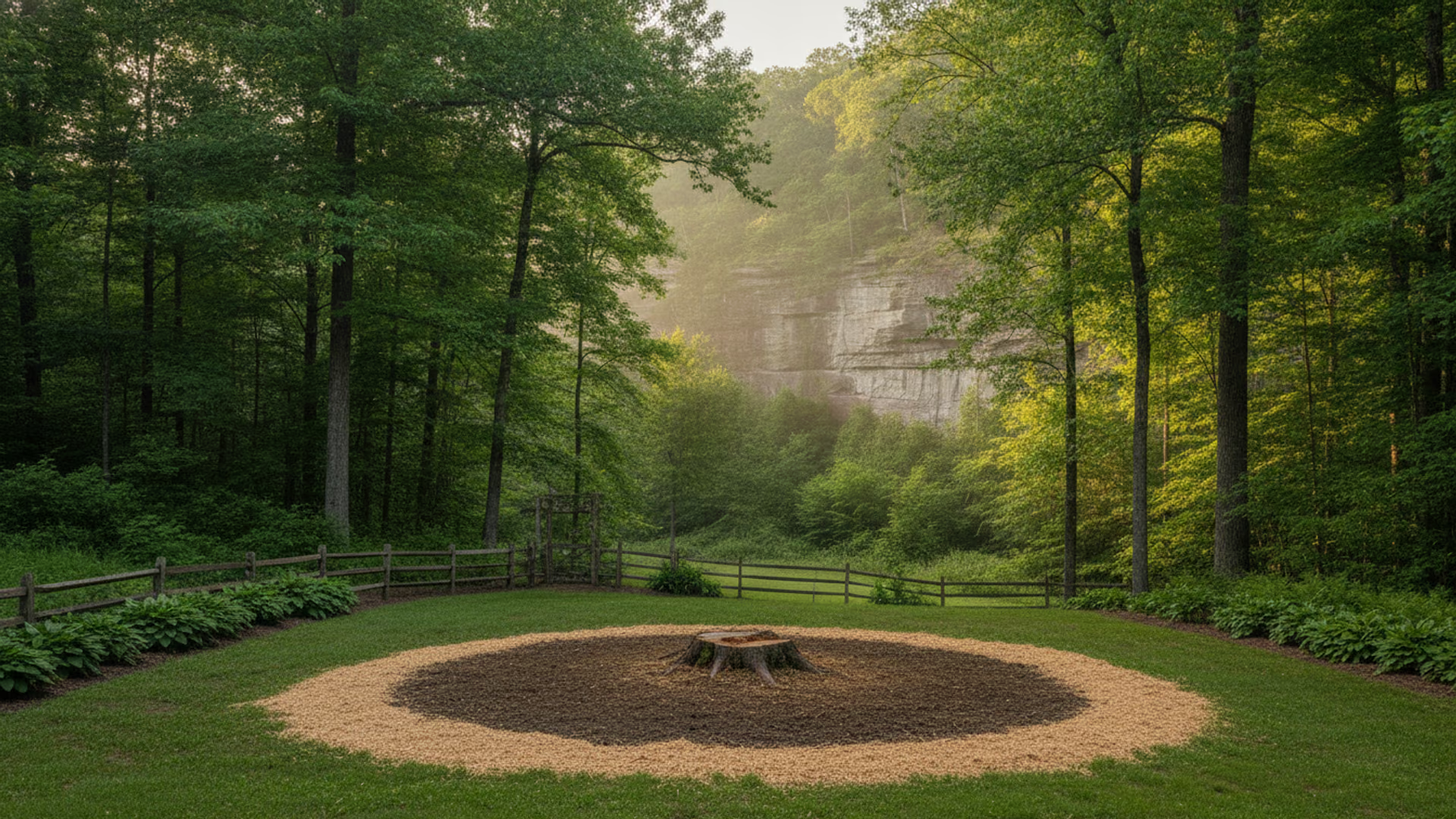
Then cleanup. Brush is chipped, wood is bucked and hauled — or stacked for your wood stove if you'd rather keep it — and the site is raked. You're left with a stump at grade and your lawn, not a weekend of dragging limbs.
What Tree Removal Costs
Tree removal cost comes down to physical facts: how tall the tree is, how thick the trunk is, how close equipment can get, and what's underneath it. A tree with room to fall in open grass sits at the bottom of any range. A tree over a cabin roof or a power drop, at the end of a steep gravel drive, sits at the top — every piece has to be rigged or craned, and that's time. Condition matters too: brittle standing-dead ash takes slower, more careful work than sound live wood. Nationally, most removals land between a few hundred dollars for a small tree and a few thousand for a large tree over a structure; your number comes from a written estimate, never a guess over the phone.
Two things make the bill easier to handle: Special Financing Available, and — when a tree has already come down on a covered structure — we work with major insurance providers and document the job to support your claim. And one thing to watch for: a bid far below everyone else's usually belongs to a crew with no insurance behind it. We're bonded and insured; ask any bidder for the same. For a deeper breakdown, see our guide to how much tree removal costs.
Storm Damage? We Answer 24/7
When a tree is on the house or across the driveway, this stops being a scheduling conversation. We offer 24/7 support and emergency tree removal, and we've handled roughly 300 emergency responses since 2015 — most of them in exactly the ice-and-wind conditions this county is known for. One rule first, always: if a tree or limb is touching a power line, your first call is the utility, not a tree crew. That span is theirs until it's de-energized. For everything after that, need emergency removal after a storm? — that page covers how storm work runs.
Where We Work
Home base is Logan, and in-town work means big, old trees: about a third of the city's homes predate 1940, with mature maples and oaks standing over old roofs and sidewalks — see our tree removal serving Logan, OH. From there the range runs northwest to tree removal in Lancaster, OH and southeast to tree removal in Athens, OH, with the cabin communities in between — Rockbridge, Lake Logan, Union Furnace, South Bloomingville — making up much of the day-to-day. If you're taking out more than a tree or two, or opening up a wooded lot for a build, that's a different job with different equipment — clearing a whole lot? See land & brush clearing.
Ready When the Tree Isn't
Eleven years, 5,000 projects, a five-star Google rating, bonded and insured, financing available, and a crew that answers at 2 a.m. when the ice comes down — that's what backs every tree removal Logan, Ohio homeowners book with us. If there's a tree on your property you've stopped trusting, request your estimate and we'll plan its exit before it plans its own.